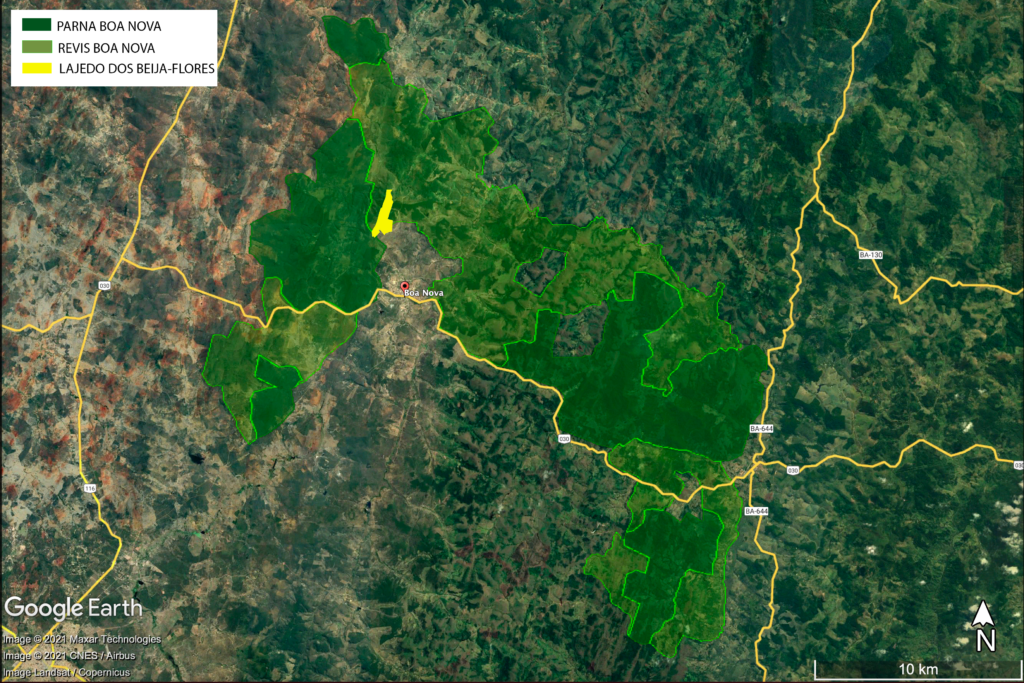
Richly blessed by nature, the entire Boa Nova region plays an important role in conserving biodiversity, acknowledged internationally. Reflecting this importance, two Conservation Units have been established here: one is a National Park (Parque Nacional de Boa Nova), and the other is a Wildlife Preserve (Refúgio de Vida Silvestre de Boa Nova).
Let’s take a tour of the protected areas surrounding the Lajedo dos Beija-Flores hummingbird sanctuary.
The Boa Nova National Park (Parque Nacional de Boa Nova) is located in southwest Bahia State. Administered at the federal level, it covers 12,065 hectares (46 square miles) and encompasses three municipalities: Boa Nova, Manoel Vitorino and Dário Meira.
Established in June 2010, its main purpose is to protect surviving patches of Atlantic Rainforest and Caatinga scrublands, as well transition zones between these biomes, commonly known as the Liana Forest. Among the world’s rarest and most endangered biomes, these seasonal forests are the main habitat of the slender antbird (Rhopornis ardesiacus). This endangered species is one of the rarest birds in the Americas.
Generously endowed with water resources, the hilly terrain of this park shelters many wellsprings, waterfalls, streams, and rivers. Its main attractions include the Cachoeira Sete de Setembro waterfall with a drop of more than 70 meters (300 feet); the Mirante do Rio Chumbo lookout point with breath-taking views over the river; and (of course!) the Lajedo dos Beija-Flores hummingbird sanctuary, which is always happy to welcome guests.
Boa Nova Wildlife Refuge – Established in June 2010 at the same time as the Boa Nova National Park, the Boa Nova Wildlife Preserve (Refúgio de Vida Silvestre de Boa Nova) is also administered at the federal level. Covering 15,023 hectares (58 square miles), it lies completely within the municipal boundaries.
It is worth stressing that Birdlife International and SAVE Brasil rate this region as an important conservation area for birds, as it is home to a high-priority group of endangered species that are endemic to the Atlantic Rainforest and the Caatinga scrublands. More than 460 bird species have already been catalogued in this region, with 24 of them endangered.
Moreover, this eco-corridor formed by the National Park and Wildlife Preserve also plays a vital role in protecting and regenerating natural ecosystems. Noteworthy among them are wellsprings and headwaters, underpinning feasible populations of many wildlife species (some endangered), and also conducting educational actions focused on environmental protection and scientific output.
Embedded in this eco-corridor, the Lajedo dos Beija-Flores hummingbird sanctuary is steered by the same commitment to providing close connections with nature, while helping preserve forests. It also offers infrastructure and guidance on birdwatching, as well as facilities that underpin the production of citizen science.
Nós armazenamos dados temporariamente para melhorar a sua experiência de navegação e recomendar conteúdo de seu interesse. Ao utilizar nossos serviços, você concorda com tal monitoramento.ConcordoPolítica de privacidade